


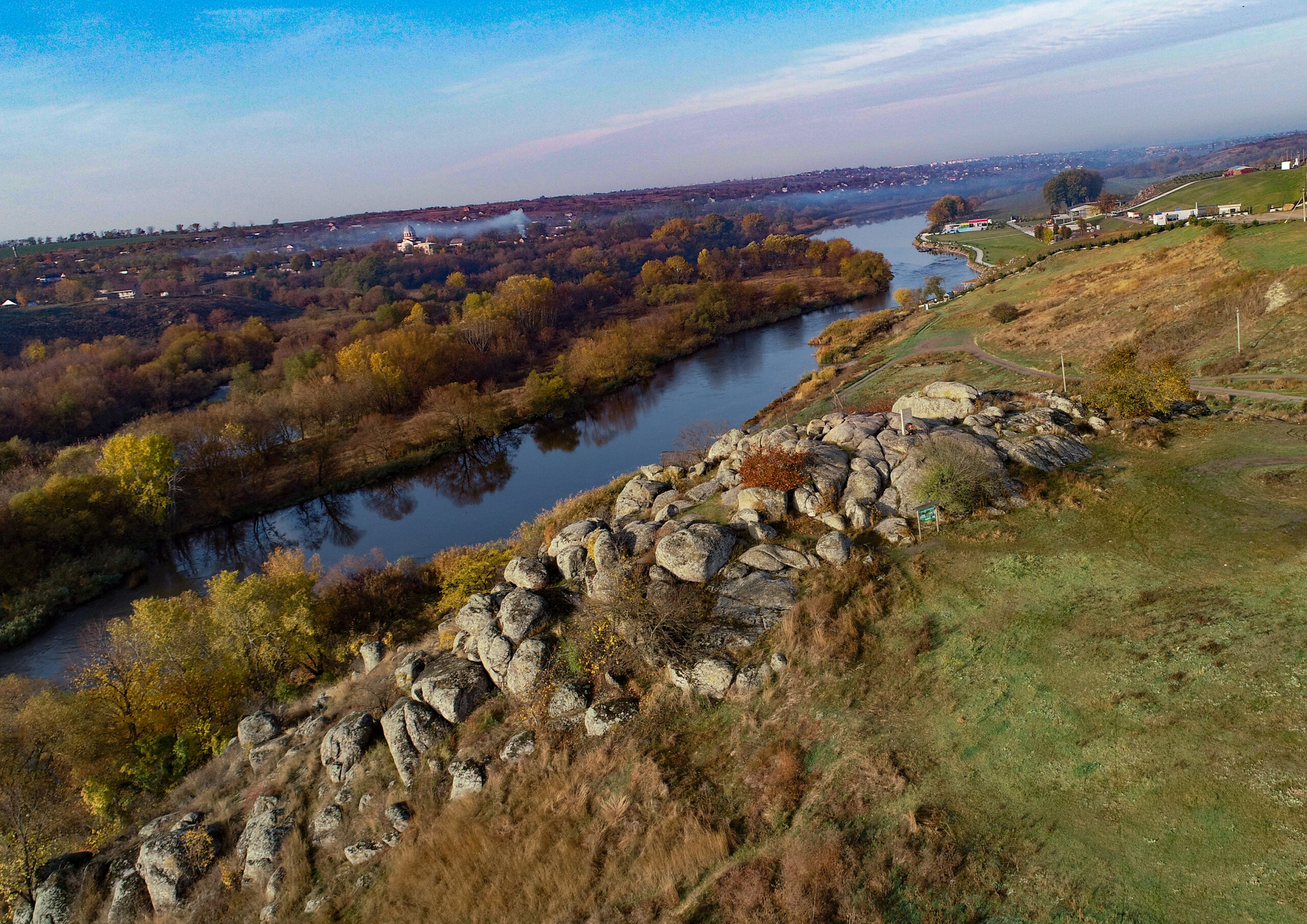
We have now climbed to Kompaniiska Rock – one of the highest points in this part of the Buzkyi Canyon within the Myhiia tract. Take a careful step closer to the edge and look down. From here, you can see the rapid channel of the Southern Bug cutting through the Kompaniiskyi Rapid, while the long Kompaniiskyi Island stretches across the middle of this segment.
Kompaniiska Rock, which forms the island, rises to about forty meters in height and consists of layered granite formations. Here you will find a stone known as the Haidamak Seat – a natural rock ledge resembling a bench, as if specially shaped for watching the river.
Looking around, you can see other notable landmarks. On the right bank, opposite Kompaniiskyi Island, stands Puhach Rock, near which a water mill once operated under a landowner named Korbe. Further downstream lies an island where, according to local legends, the haidamak Mamai once hid. Nearby you can also see the Second Myhiia Rapid. The nearby Velykyi Myhiia Island formed more than two hundred years ago and was once a peninsula with the village of Hrushivka, which was destroyed by a major flood.
Now let us turn again to the historical dimension of this place. The Myhiia tract was first recorded in 1650 on a map of Ukraine created by Guillaume de Beauplan. This is hardly surprising, as the borders of three political powers once met here – the Ottoman Empire, the Polish–Lithuanian Commonwealth, and the lands of the Zaporizhian Host. During the Haidamak uprisings, a rebel camp existed on these islands. The cliffs descended toward the water like fortress walls, while dense forests provided natural defense.
And since we are here, there is one more remarkable historical detail. In the spring of 1768, detachments of the Koliyivshchyna uprising led by Maksym Zalizniak passed through these lands, as recorded in reports by the Zaporizhian colonel Holovko. At the same time, the name Kompaniiska Rock, along with the nearby ravine and rapids, preserves the memory of the tragic death of Cossacks from the Kompaniiskyi Regiment under Vasyl Chasnyk during a Tatar attack in 1769.
Returning to the present, this is a place where stone, water, and human history merge into a single living memory – which is exactly what makes it so remarkable.