


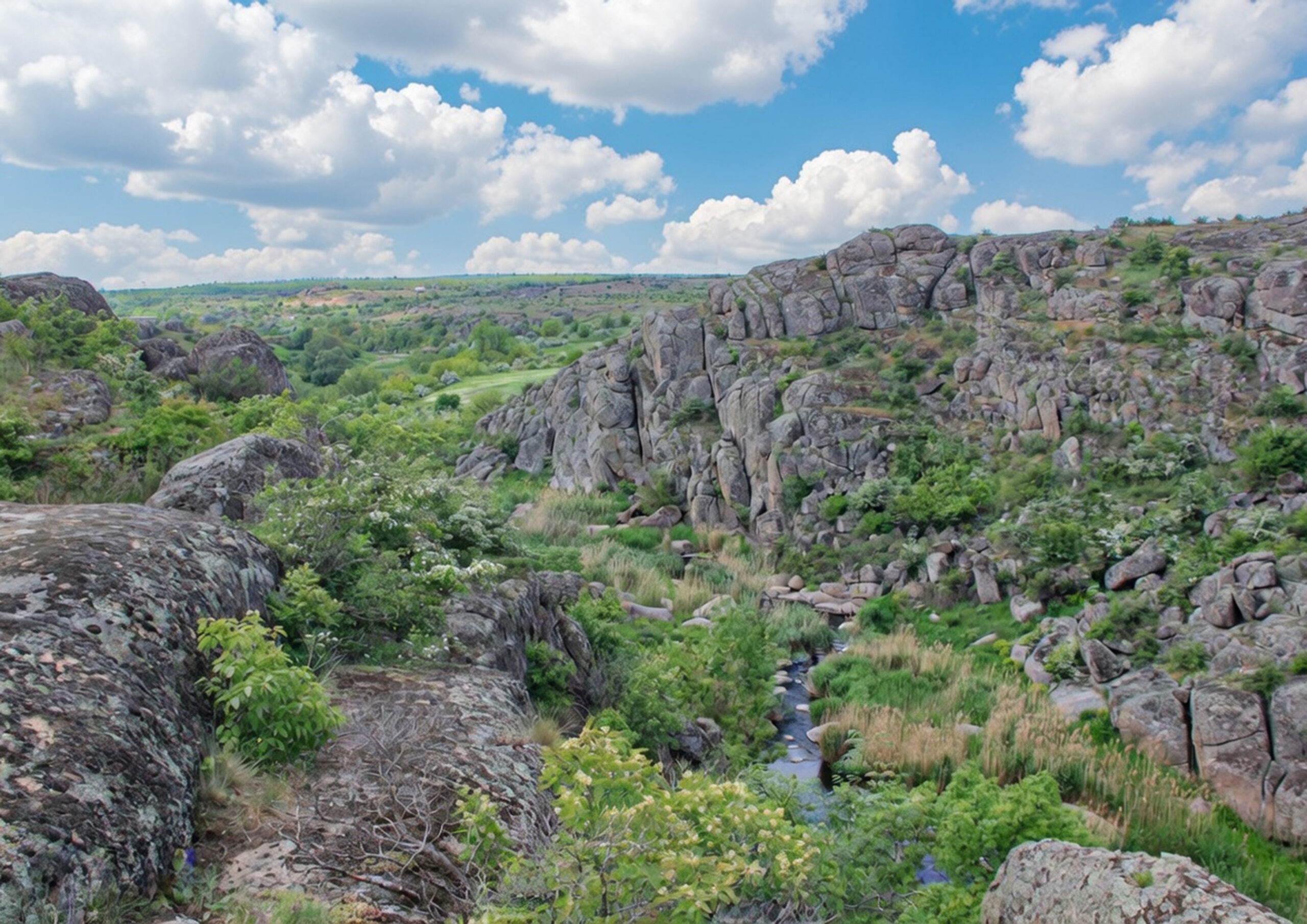
We are now in a place where history stretches back thousands of years, and where the cliffs seem to hold the memory of events that shaped this land. An intriguing fact: in the late Middle Ages, Aktove Canyon bore the Tatar name Sahaidak, derived from its resemblance to the curved shape of a bow quiver.
These very lands were mentioned by the ancient Greek historian Herodotus in the fourth book, Melpomene, of his Histories. He wrote that near the river Hypanis – the ancient name of the Southern Bug – at the boundary between the lands of the Scythian ploughmen and the Alazones, a bitter spring flowed into the river from the left. Herodotus called this place Exampaeus, a name that in Iranian languages is interpreted as “dead water,” and in Greek as “Sacred Ways.”
Most scholars associate this name with the origin of the modern river name Mertvovod. It has endured for centuries with little change, preserving a deep symbolic meaning. According to one interpretation, Scythian rulers were once carried along the banks of the Mertvovod on their final journey to burial sites among the cliffs. Yet other explanations of the name survive in local folklore.
One legend tells of a fierce battle between Cossacks and Tatars, after which the river was said to have turned red with blood, its waters appearing lifeless. Another story recounts how, during a Tatar raid, local inhabitants hiding in the ravines prepared poison from herbs and poured it into the river upstream from the invaders’ camp. Many enemies perished after drinking the water, and thus, the river is said to have received its ominous name.
Today, Aktove Canyon greets visitors with silence and grandeur. Yet among the granite cliffs, where only the midday sun reaches, there lingers a distinct, almost mystical atmosphere. This place holds memory of suffering, fear, and hope alike. For that reason, it stands not only as a natural monument, but also as a historical landmark, preserving the echoes of events long past.