


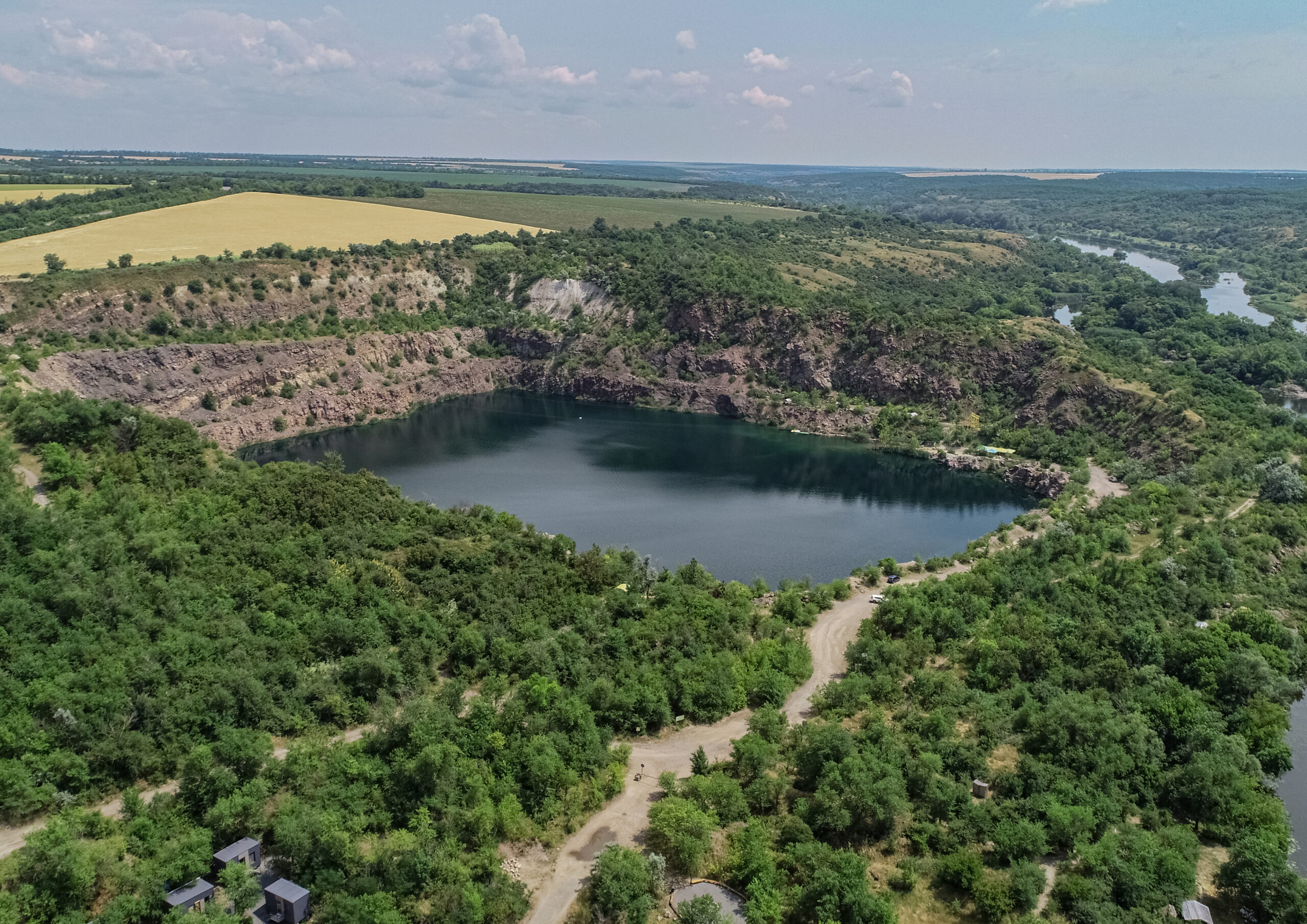
We are now standing beside a lake whose distinct character immediately sets it apart from other water bodies in the area. Radon Lake near Myhiia formed in the basin of a former granite quarry. When stone extraction ceased, the pit gradually filled with groundwater. In this way, human intervention unexpectedly gave rise to a new natural site.
The lake reaches a depth of approximately twenty-four meters. Its water is exceptionally clear and displays a striking blue-turquoise hue that shifts with changing light and seasons. It is this clarity and color that immediately draw the eye and give the landscape an almost unreal appearance.
The distinctive coloring of the water is linked to dissolved radon – a naturally occurring inert gas formed during radioactive decay within rocks. There is no cause for concern: the concentration of radon in the lake remains within safe limits. In various parts of the world, radon-rich waters are valued for their therapeutic properties, although this particular site is primarily of scientific and natural interest.
The lake formed within the granites of the Ukrainian Shield – one of the oldest geological structures in Europe. These rocks are more than two billion years old. They also shape the surrounding cliffs, canyons, rapids of the Southern Bug, and the granite islands encountered earlier along our route.
Within cracks and exposed granite surfaces, rare species of flora and fauna have adapted to the harsh conditions of the rocky environment. On the granite walls surrounding Radon Lake, you may encounter reptiles such as the Aesculapian snake and the European green lizard.
Radon Lake offers a rare opportunity to look deep into the geological history of the Earth and to understand that even landscapes shaped by human activity can become part of natural heritage – if nature is given the freedom to follow its own laws.