


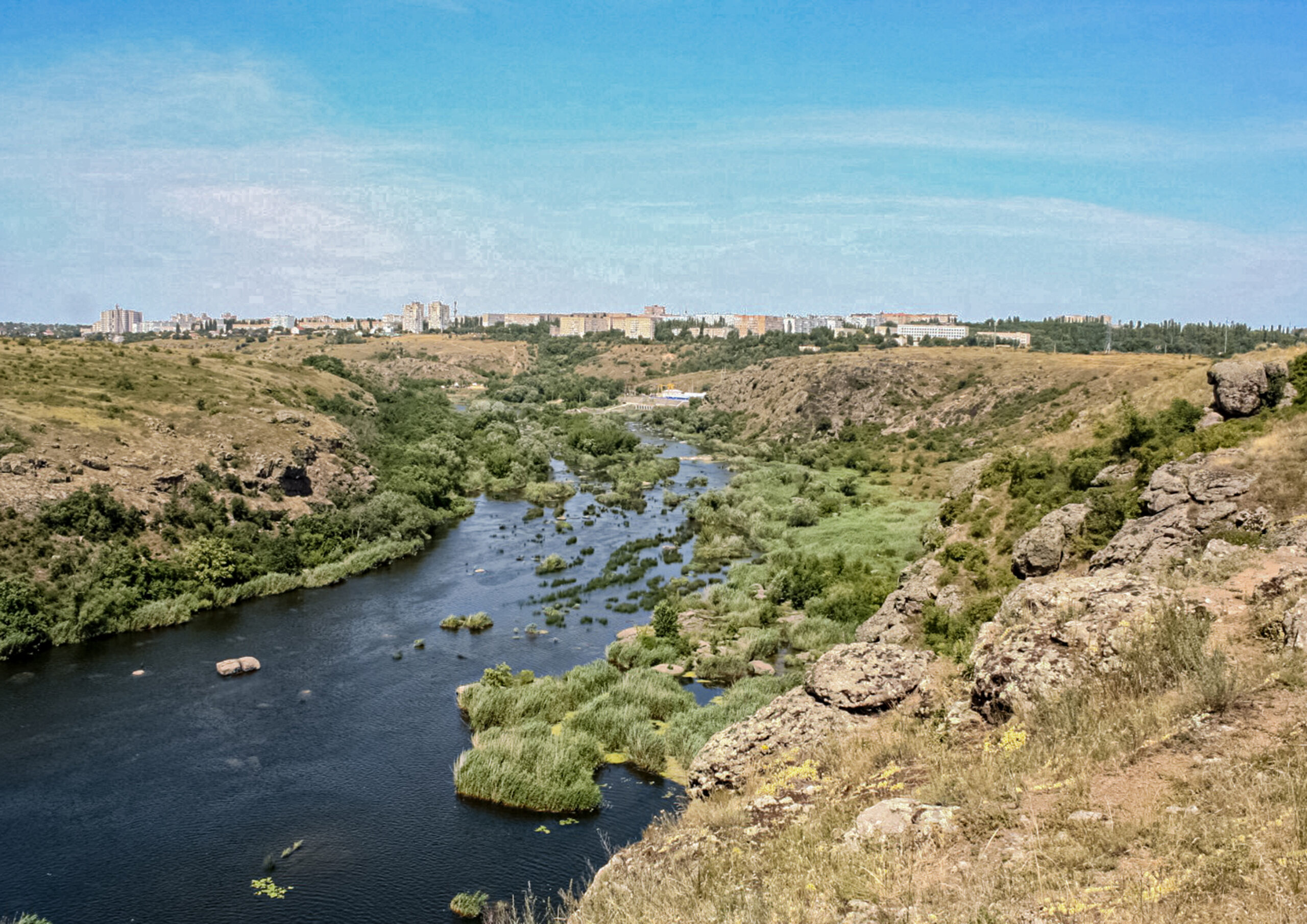
Next, we will visit three stops devoted to the Gard tract – one of the most significant sites along the middle course of the Southern Bug. It is here that the river cuts through a deep and narrow canyon, creating one of the most striking landscapes of the Granite-Steppe Bug region. In 2008, this area was included in the list of the “Seven Natural Wonders of Ukraine,” a national initiative aimed at promoting the country’s unique natural landmarks and drawing attention to their conservation.
The modern steppe, which formed after the last Ice Age several thousand years ago, has been preserved on the granite outcrops of the Bug region. Around fifteen thousand years ago, archaeological evidence suggests that bison once roamed these lands. Over millennia, local grasses accumulated organic matter, gradually forming the rich black soils for which Ukraine is renowned.
One of the most recognizable plants of the steppe is feather grass – a perennial grass with fine, silvery awns that sway in the wind. For centuries, feather grass has defined the appearance of the Ukrainian steppe and has become its symbol. Ten rare species of this plant can be found within Buzkyi Gard, making this area an important refuge for authentic steppe ecosystems.
Here, the Southern Bug is pressed tightly between the granite cliffs of the Ukrainian Shield. The ancient geological formation rises directly to the surface, shaping steep banks and a rapid that stretches for more than half a kilometer.
On the left bank stand three easily recognizable cliffs – Owl Rock, Gate Rock, and Eagle Owl Rock. They shape the distinctive landscape of the canyon and have long served as natural landmarks. Opposite Eagle Owl Rock lies Gard Island. It is from this island and the rapid of the same name that the entire tract takes its name.
Turning to the historical context, the Gard was a place where major river crossings, fishing grounds, and trade routes converged. The combination of a rapid and a canyon provided natural defense, giving this territory strategic importance in different historical periods.
Places like the Gard have always become centers of activity – stopping points along the way and locations from which control over the river could be maintained. The word “gard” itself once meant a stone weir or a place used for catching fish.
Standing here, breathing in the scent of blooming steppe grasses and hearing the distant cry of a kestrel, it becomes clear why this place came to be the heart of the Bug-Gard region.