


Here we will visit three nearby stops. Each of them offers a deeper understanding of this truly remarkable place.
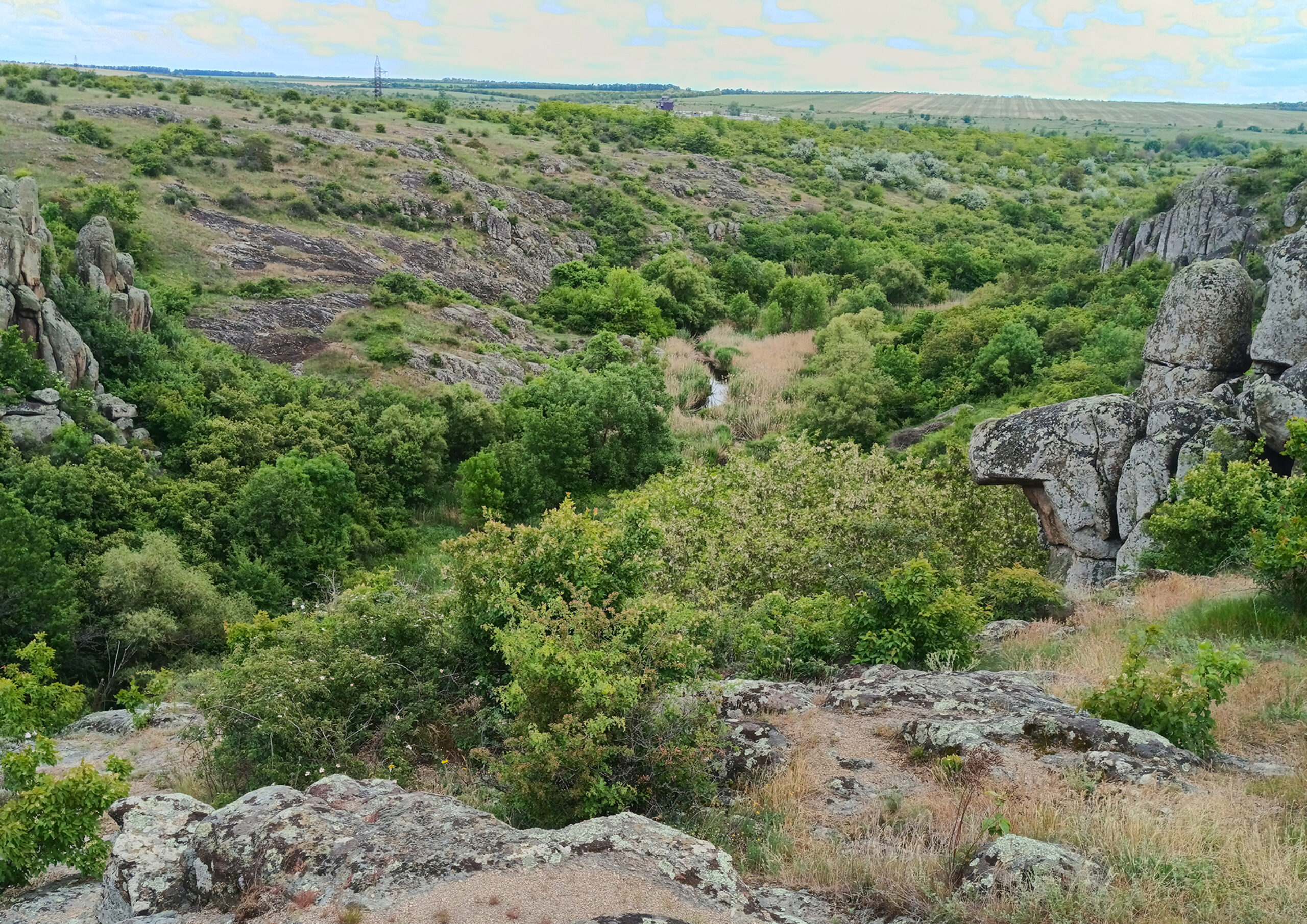
We are now standing beside one of the most striking natural formations in southern Ukraine – Aktove Canyon. It is often compared to the mountainous landscapes of the Caucasus or Scandinavia, though it is worth remembering that we are still within the Ukrainian steppe. The canyon covers more than 250 hectares and uniquely combines elements of forest, aquatic, and rocky ecosystems. Since 2009, Aktove Canyon has been part of the Buzkyi Gard National Nature Park.
This landscape was shaped by the Mertvovod River, which over thousands of years carved its way through the granites of the Ukrainian Crystalline Shield. In some places, the canyon reaches depths of up to 60 meters, and its steep slopes are formed from some of the oldest crystalline rocks in Eurasia – granites more than two billion years old. In certain areas, the rock formations exceed three and a half billion years in age. These geological structures were formed during the early stages of our planet’s history, when the Earth was still taking on its present form. Within the stone, one can find garnet crystals and pyrite – often called “fool’s gold” because of its resemblance to real gold. Here, the very foundations of the Earth’s geological history are laid bare.
The Mertvovod River stretches for 114 kilometers. Flowing through the steppes of Kirovohrad and Mykolaiv regions, it joins the Southern Bug as a left tributary. Its drainage basin is fed by a network of 148 small rivers and streams. Near the villages of Aktove and Trykraty, the river appears especially impressive, cutting directly through the rock mass to form rapids, massive boulders, and stone labyrinths.
Yet not everything is as pristine as it may seem. The present condition of the Mertvovod is a cause for concern. In the twentieth century, human activity – the construction of dams and the ploughing of riverbanks to the water’s edge – significantly altered its natural regime. This led to slower currents, silted channels, and overgrown banks.
Despite these pressures, Aktove Canyon remains a unique natural sanctuary. Rare plant and animal species persist here, a distinct microclimate has formed, and the contrast between rock, water, and steppe creates a powerful emotional impression. This place does more than inspire admiration. It invites reflection on humanity’s responsibility to safeguard a natural heritage that has been shaped over millions of years.