


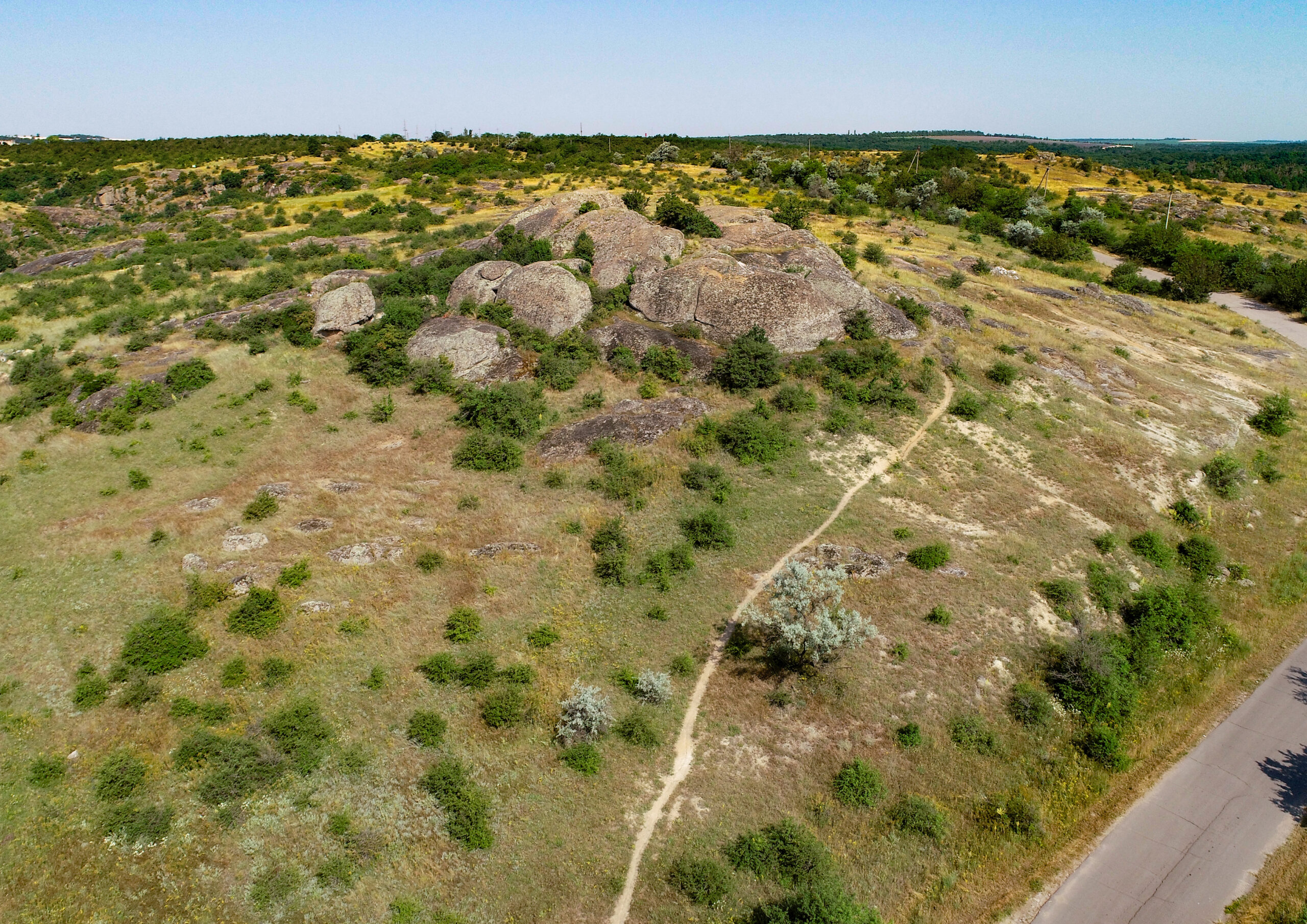
Locals call this place the “Navel of the Earth” – and not without reason. We are standing at the highest landscape point in this area. From here, a sweeping panorama opens across the canyon of the Arbuzynka River and the weathered kaolin mounds along the edges of a former granite quarry – silent traces of human intervention. You can also see the bridge leading to the village of Aktove, as well as the point where the Arbuzynka meets the Mertvovod River. In the distance lies the Vasyleva Pasika tract, now home to a colonial nesting site of grey herons, sometimes numbering up to one hundred nests.
The Vasyleva Pasika tract was established in 1825 by Viktor Skarzhynskyi, whom we mentioned several stops earlier. One of his peasants, Vasyl, organized a large forest apiary here that brought considerable profit. It was from his name that the tract received the title by which it is still known today. This area forms a man-made oak grove of approximately 250 hectares. Oak, ash, maple, and hazel grow here alongside numerous shrubs and herbaceous plants. Along the streams, meadow and wetland vegetation thrives, while the granite outcrops preserve pockets of petrophytic steppe adapted to thin, rocky soils.
It was the reliable water supply, fertile steppe lands, and naturally protected rocky valleys that encouraged people to settle here since ancient times. Archaeological research confirms continuous human presence from prehistoric periods onward. Numerous burial mounds and ancient settlements scattered across the landscape bear witness to this long history.
Now it is time to continue toward the outskirts of the village of Aktove, where the unique landscapes of Aktove Canyon await.