



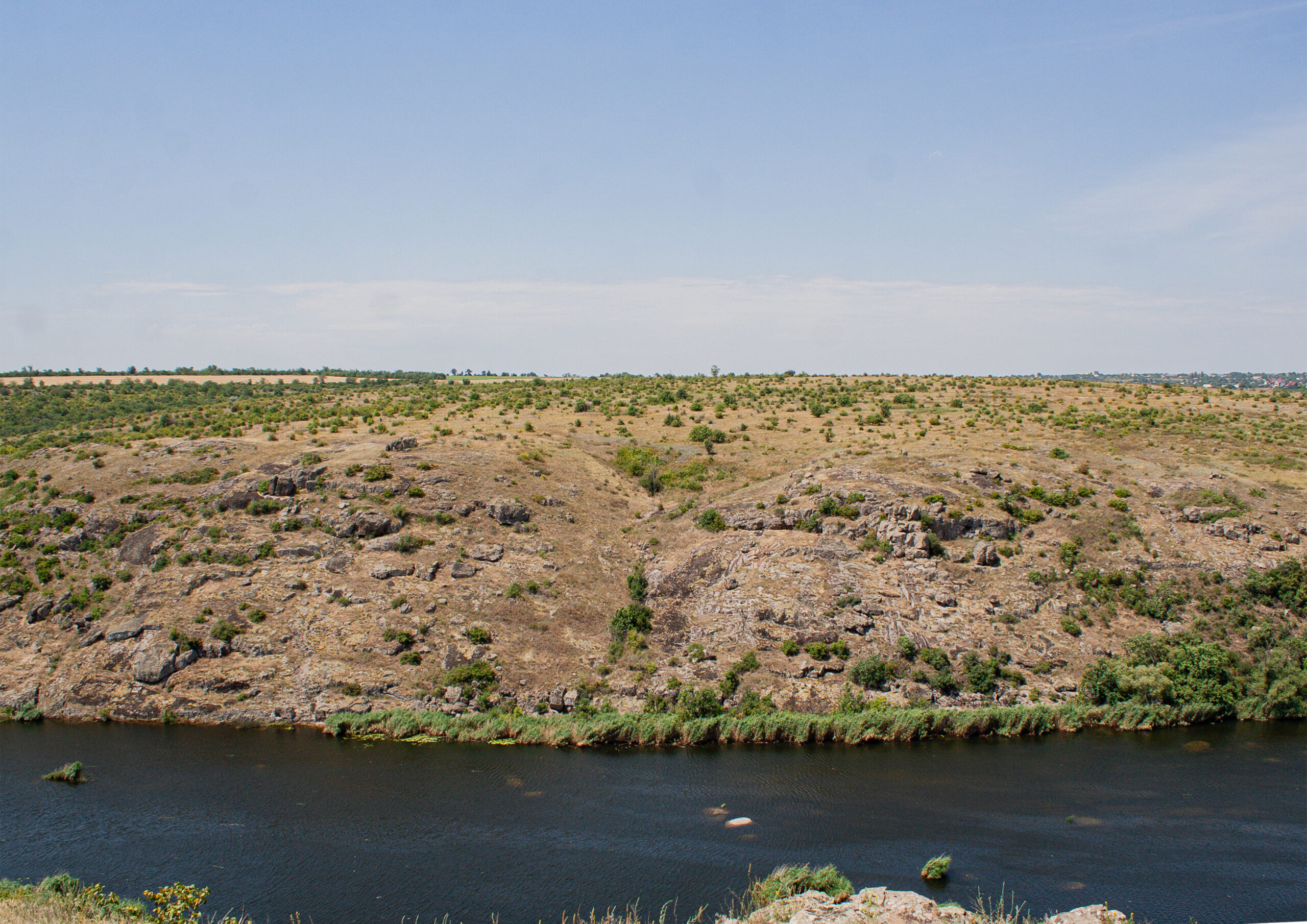
We are now in a place that once became one of the key centers of Zaporizhian Cossack life. It was within the steppe of the Wild Field that Ukrainian Cossack life took shape. The Zaporizhian Gard was a well-organized structure combining military service, economic activity, and spiritual life. It served as the main administrative center of a vast territory – the Bug-Gard Palanka of the Zaporizhian Host.
Each summer, up to five hundred Cossacks stayed here. They lived in kurins and dugouts, guarded the borders of the Zaporizhian Sich, and controlled river crossings and fishing grounds along the Southern Bug. For them, the river was not only a source of food but also a strategic line that required constant presence and defense.
An important historical source is a plan drawn in 1742 by the French engineer Daniel de Bosquet. It provides a detailed depiction of the structure of the Zaporizhian Gard. On Gard Island, sometimes later referred to as Klepanyi Island, there were Cossack dwellings, a fish-processing facility, and a field church dedicated to the Intercession of the Holy Virgin.
In the Palankova ravine stood a military camp and a cemetery, indicating that people settled here for extended periods rather than merely stopping temporarily. Archaeological discoveries within the Gard confirm this. Among the finds are fragments of ceramic vessels, stove tiles, and iron household items – everyday objects that once belonged to the Cossack community.
Researchers have also identified the remains of a structure in the northern part of Gard Island, believed to be connected to the field church. This once again underscores that the spiritual dimension was an integral part of Cossack life.
Yet people chose the Gard tract as a place of settlement not only during the existence of the Zaporizhian Sich. Archaeological research has uncovered numerous layers of cultural remains, superimposed over at least eight thousand years. These include the Mesolithic, Neolithic, Eneolithic, Bronze Age, Antiquity, and the Early and Late Middle Ages.
And now it is time to move on, for the Gard still holds many places worthy of attention.